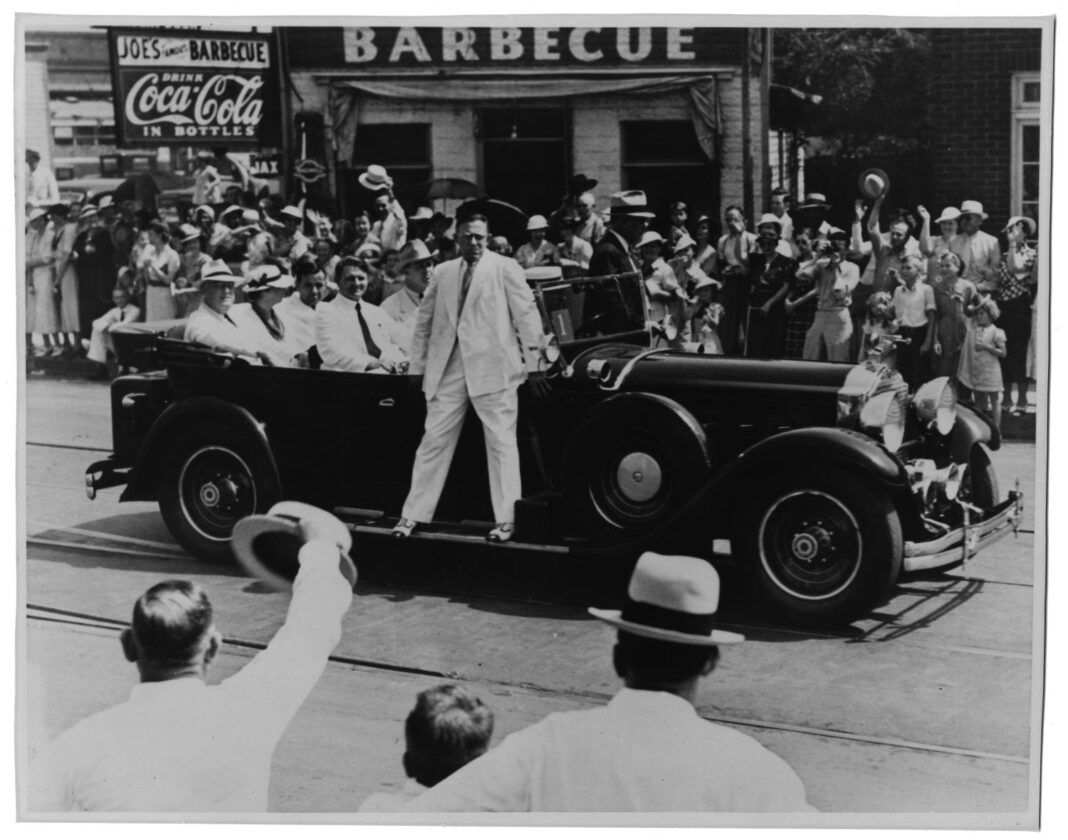

In June 1936, Dallas was buzzing with excitement. The city was eagerly awaiting the arrival of Franklin Delano Roosevelt, the 32nd President of the United States. The reason for the buzz? Roosevelt was in the midst of his re-election campaign, seeking a second term. As a major hub in Texas, Dallas was a crucial stop on his campaign trail. Read on at dallas-yes.
This visit also coincided with a major event: the Texas Centennial Exposition. This added an extra layer of festivity to the president’s arrival. Thousands of residents, full of joy and enthusiasm, lined the streets. Everyone hoped to catch at least a glimpse of their leader. The day went down in Dallas history as a symbol of unity and a significant political moment, vividly showcasing the immense public support for the president.
Dallas Prepares for the Presidential Visit
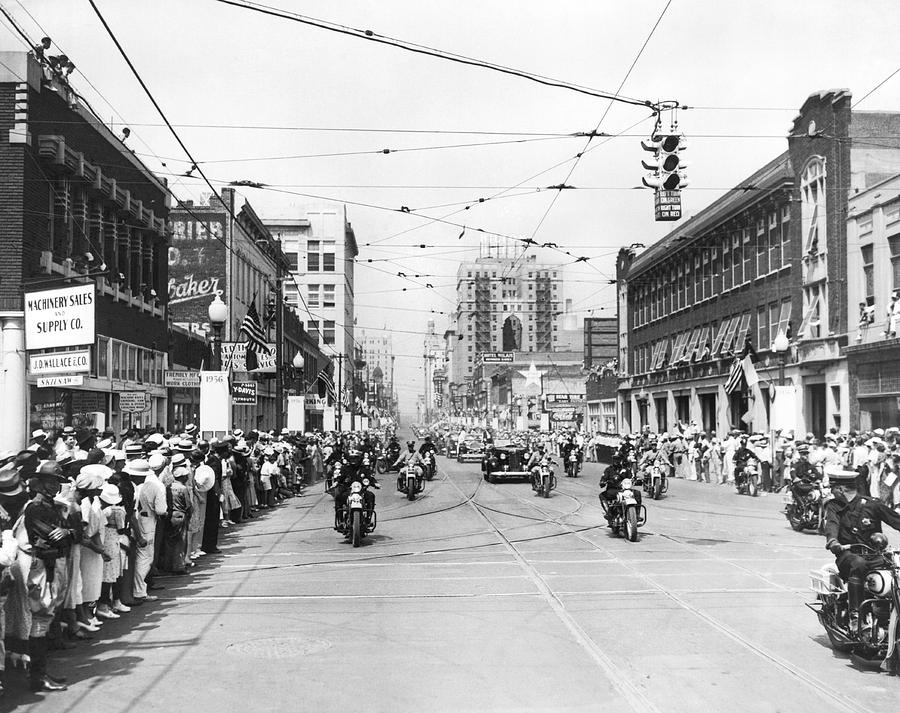
President Roosevelt’s visit to Dallas on June 12, 1936, was more than just a routine campaign stop. It was an event that perfectly blended political objectives with the celebrations of the Texas Centennial Exposition. The political context of Roosevelt’s trip was highlighted by the fact that on the very same day, Alf Landon was nominated as the Republican presidential candidate in Cleveland, Ohio.
At 9:30 AM, the presidential train pulled into Union Terminal in Dallas. Thousands of citizens gathered on the Houston Street Viaduct to watch as Franklin and Eleanor Roosevelt disembarked from the train and entered an open touring car. A multi-mile journey to Fair Park awaited them. Main Street was packed with people hoping to catch a momentary glance of the popular president and his equally famous wife. Many shops along the route even closed for the day, as it made little sense to stay open when all the customers were out on the streets. After all, it wasn’t every day that the President of the United States came to town. Roosevelt must have been delighted by the enthusiastic reception as his motorcade passed through downtown Dallas. People waved and cheered from all directions, while ticker tape and torn paper rained down from the upper-floor windows of office buildings.
Franklin Roosevelt in Dallas
Upon arriving at Fair Park, Roosevelt’s car passed through the gates near the Fair Park Auditorium, proceeded down First Avenue, turned left onto Grand Avenue, and drove past the Federal Building and the Hall of State. As a 21-gun pyrotechnic salute boomed overhead, they entered the Cotton Bowl. According to the Times Herald, a mighty, continuous roar erupted from the 50,000 people in the stadium as they saw the president’s car drive up the ramp. On a high, flag-draped stage in the center of the Cotton Bowl, Texas Governor James Allred introduced Roosevelt as “the greatest friend the people of the United States have ever had in the White House.” The crowd’s cheers left no doubt that few in the stadium would have disagreed with that statement.
The president, dressed in a white suit, stood at the podium and delivered a thirty-minute speech broadcast on national radio. Hailing the “Empire of Texas,” Roosevelt seized the opportunity to sharply criticize monopolies, calling them “the enemy of democracy.” After his speech, the President and Mrs. Roosevelt left the Cotton Bowl for a brief tour of the exposition. They then headed to the Adolphus Hotel downtown for a luncheon with local civic leaders and representatives from the Centennial Exposition.
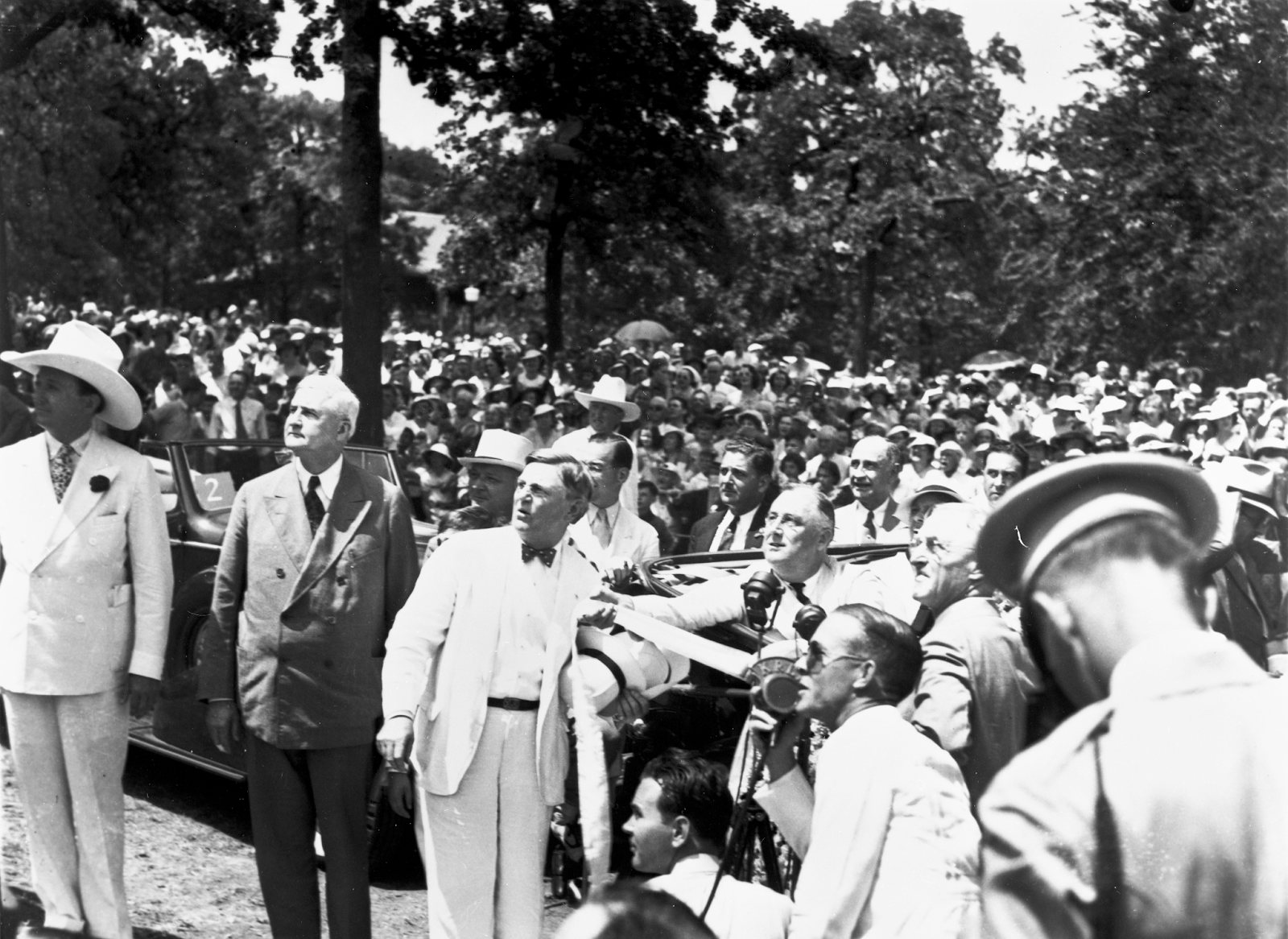
Following the luncheon, Roosevelt left the Adolphus for his third and final official event of the day. At Oak Lawn Park (now Lee Park), another enthusiastic and excited crowd greeted the president. To the wild cheers of the crowd, the president, seated in his car, unveiled a statue of General Robert E. Lee and delivered a short speech honoring the Confederate hero.
The Content of Roosevelt’s Speech
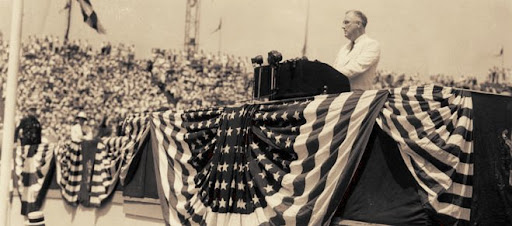
During his speech at the Cotton Bowl, Franklin Roosevelt wasn’t just addressing Texans—he was speaking about the fundamental principles of democracy and economic recovery, which were crucial for the entire nation in the midst of the Great Depression. His nationally broadcast address became a powerful manifesto against monopolies, which he argued undermined the foundations of a democracy of opportunity. He emphasized that true freedom is not possible without economic equality and that the concentration of control in the hands of a few powerful groups threatened government stability and democratic institutions themselves.
Roosevelt recalled the history of Texas, noting how the state had fought for its independence and endured the difficult times of the Civil War and Reconstruction. He pointed out that Texas farmers were among the first to rise up against exploitation by the railroads and that Texas pioneered the regulation of public utilities for the benefit of their users. He also praised the state’s antitrust laws, which, he said, had ensured prosperity and freedom from the domination of special interests long before similar ideas took hold across the country. For Roosevelt, Texas was a shining example of a region that was not afraid to challenge injustice and defend the principles of individual liberty.
The president stressed that Texas’s success was closely linked to the well-being of the entire nation. He spoke of the interdependence of every state, explaining that the prosperity of Texas farms, ranches, and factories was only possible because other parts of the country had enough purchasing power to consume their products. Conversely, thousands of factories and farms in the North and East were able to sell their goods thanks to the prosperity of Texans. This idea of national cooperation and a “Good Neighbor” policy was central to his vision for the country’s recovery.
Roosevelt expressed his pleasure at the decline of sectionalism over the past three years, emphasizing that the country had begun to think nationally. He drew a parallel between the domestic Good Neighbor policy and foreign policy, specifically mentioning the Texas border with Mexico. This allowed him to pivot to the topic of international relations, stressing the United States’ commitment to peace in the Western Hemisphere and the expansion of the principles of goodwill and friendship.
Thus, Roosevelt’s visit to Dallas became more than just a campaign rally; it was a powerful platform for promoting his political philosophy and his vision for America’s future, with Texas serving as a symbol of resilience, progress, and national unity.
The Aftermath of the Presidential Visit
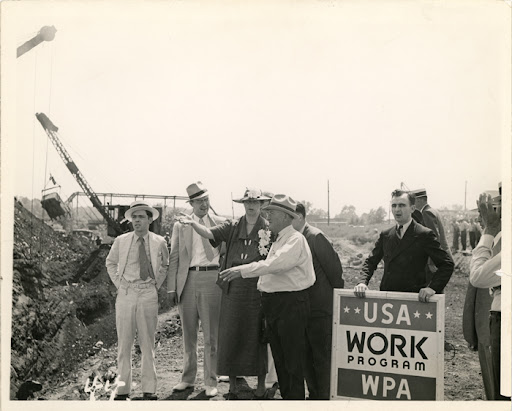
From Oak Lawn Park, the Roosevelts, along with their son Elliott, departed for his estate near Fort Worth, where they spent the night. The next morning, the presidential delegation left for Indiana, concluding their time in the Lone Star State.
Franklin Roosevelt’s 1936 visit to Dallas was a landmark event that not only highlighted his political presence during the election campaign but also strengthened the bond between the federal government and the state of Texas. His speech, particularly its critique of monopolies, resonated with many Americans during the Great Depression. Furthermore, his participation in the Centennial Exposition and the unveiling of the monument reflected his appreciation for the nation’s historical heritage and cultural life. The president’s arrival, met with massive support and a festive atmosphere, undoubtedly left a lasting mark on Dallas’s history and reaffirmed its importance on the national stage.
Sources: